

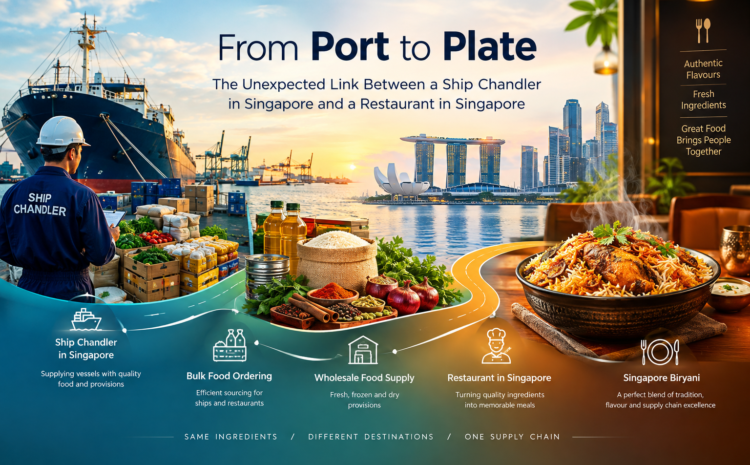
When you sit down to enjoy a fragrant plate of biryani in Singapore, the last thing you probably think about is a ship waiting at the port.
Yet, behind the scenes, Singapore’s maritime supply chain and its vibrant restaurant industry can have something surprisingly important in common: food provisioning.
From basmati rice and cooking oil to spices, meat, canned goods and specialty ingredients, both ships and restaurants depend on reliable food suppliers capable of handling quality, quantity and tight delivery schedules.
This is where a ship chandler in Singapore enters the story.
Traditionally, ship chandlers supply vessels with everything required for life at sea, including fresh food, frozen products, dry provisions, beverages and other essential stores. Singapore’s position as a major maritime hub makes ship chandling and marine supply a highly coordinated business where timing and reliability matter.
Interestingly, many of the same principles that keep a ship’s galley running can also help explain what goes into creating a memorable restaurant meal.
What Is a Ship Chandler and What Does It Actually Supply?
A ship chandler is essentially a specialist supplier for vessels. Instead of a restaurant ordering ingredients for its kitchen, a vessel may require food and provisions for its crew before continuing its voyage.
A professional ship chandler in Singapore may supply:
- Fresh fruits and vegetables
- Meat, poultry and seafood
- Frozen food
- Rice, flour, noodles and other dry provisions
- Canned food
- Dairy products
- Beverages
- Spices and condiments
- Specialty and dietary food products
Singapore-based provisioning companies commonly handle fresh, frozen and dry stores, while coordinating deliveries directly to vessels at berths or anchorage points.
The key difference is scale and logistics. A vessel may need provisions for an entire crew and voyage, meaning bulk food ordering is often essential.
And that brings us closer to the restaurant industry.
The Common Ground: Bulk Food Ordering
Restaurants also operate on a supply model where consistency and volume matter.
Imagine a restaurant serving hundreds of customers every week. It cannot simply visit a supermarket whenever it runs out of basmati rice, onions, chicken or spices.
Instead, restaurants depend on wholesale food suppliers in Singapore, distributors and food provision companies that can provide ingredients in larger quantities and on predictable schedules.
This is where ship chandling and restaurant supply overlap. A supplier experienced in handling bulk provisions understands the importance of:
Volume: Large orders need accurate quantities and efficient handling.
Consistency: Restaurants need ingredients that deliver the same quality from one delivery to the next.
Freshness: Perishable products require appropriate storage and transportation.
Reliability: A delayed food delivery can disrupt an entire kitchen operation.
Product variety: One supplier may need to source dozens or even hundreds of different products.
Some Singapore provision suppliers explicitly serve both the ship chandling and restaurant sectors, supplying products such as dairy, canned food, dried fruits, beverages and specialty products.
So, while a ship and a restaurant may appear worlds apart, their procurement needs can be remarkably similar.
From Basmati Rice to Biryani: Where the Connection Gets Delicious
Now consider one of Singapore’s most popular South Asian comfort foods: biryani.
A great biryani is not simply rice mixed with meat and spices. The final dish depends on the quality and availability of its ingredients.
Premium basmati rice, meat, onions, herbs, whole spices, cooking oil or ghee and other ingredients must come together in the correct proportions.
At Biryani Singapore, the menu reflects the variety that modern diners expect from South Asian cuisine. Its current offerings include Chicken Dum Biryani, Young Mutton Dum Biryani, Prawn Biryani, Grill Fish Biryani, Lamb Shank Dum Biryani, Lamb Chop Dum Biryani, Tandoori Chicken Biryani, Chicken Tikka Biryani, Egg Dum Biryani, Paneer Dum Biryani, Mushroom Dum Biryani and Vegetable Dum Biryani.
That variety highlights an important point restaurant food begins with supply-chain discipline long before it reaches the plate.
Why Ingredient Quality Matters for Singapore Biryani
The heart of dum biryani is its slow-cooking technique.
At Biryani Singapore, the preparation process involves marinating halal meat with spices, partially cooking the basmati rice, layering the ingredients and sealing the cooking vessel before allowing the biryani to cook over controlled heat. According to the restaurant’s description, the sealed cooking method allows steam to infuse the rice with the flavours of the meat and spices.
That process makes ingredient quality particularly important.
Consider basmati rice. Every grain needs to remain aromatic and suitably textured. Meat needs to be fresh and properly prepared. Spices need to deliver their intended fragrance and flavour.
This is why restaurant food supply in Singapore is more than simply buying ingredients. It is about establishing a dependable supply chain that supports the kitchen’s recipes.
Bulk Ordering Is Not Just for Ships
The term “bulk ordering” may immediately make you think about ship provisioning, but restaurants have their own version of the same requirement.
For example, Biryani Singapore has a production capacity of up to 10,000 plates of biryani, making it suitable for large-scale catering, corporate events, and bulk food orders. This is where bulk food supply becomes particularly useful.
Corporate events, weddings, family celebrations, office lunches, and community gatherings can generate sudden demand for large quantities of prepared food.
A restaurant that already understands volume purchasing and ingredient management is better positioned to handle these occasions without compromising its core recipes.
Ship Chandlers and Restaurants: Two Industries Built Around Timing
There is another unexpected similarity between a Singapore ship chandler and a busy restaurant: timing is everything.
For a vessel, provisions may need to arrive during a narrow port-call window. Delays can affect the vessel’s schedule.
For a restaurant, ingredients need to arrive before preparation begins. A shortage of a key ingredient can affect an entire menu.
This creates a shared philosophy: Order accurately. Source responsibly. Store correctly. Deliver on time.
Professional ship provisioning companies emphasize rapid turnaround, quality checks, cold-chain management and coordinated delivery because vessels operate according to strict schedules.
Restaurants apply similar principles in their own kitchens, although their customers are sitting at tables rather than sailing across oceans.
The Bigger Picture: Singapore’s Food Supply Ecosystem
Singapore is uniquely positioned at the intersection of global trade, maritime logistics, and international food culture.
A restaurant can serve Indian, South Asian, Chinese, Malay, Japanese, or Western cuisine while depending on a complex network of local and international suppliers. That means the journey of a meal can be much longer than it appears.
A grain of rice may pass through multiple stages of sourcing, transportation, storage, and distribution before becoming part of a biryani served in Singapore.
The same infrastructure that supports Singapore’s position as a maritime hub also contributes to an environment where businesses can source a diverse range of food products efficiently.
For ship chandlers, the objective is keeping crews supplied during their voyage. For restaurants, the objective is keeping diners satisfied. The end customer is different, but the importance of a dependable supply chain remains.
Why Bulk Food Supply Matters for the Future
As Singapore’s food and hospitality industry continues to evolve, efficient procurement will remain important.
Restaurants increasingly need suppliers who can provide:
- Reliable wholesale food delivery
- Fresh and frozen provisions
- Dry food supplies
- Specialty ingredients
- Competitive bulk ordering
- Consistent product quality
- Flexible delivery schedules
At the same time, ship chandlers must continue meeting the diverse dietary and cultural requirements of international crews.
This creates opportunities for food suppliers capable of serving multiple industries while maintaining high standards in sourcing, storage, and logistics.
From Port to Plate: One Supply Chain, Many Stories
The next time you enjoy a steaming plate of Singapore biryani, think beyond the spices and rice. Behind that plate is a larger story about sourcing, logistics, bulk ordering, and food distribution.
A ship chandler may be supplying provisions to a vessel preparing for its next voyage. A restaurant may be receiving wholesale ingredients for its next dinner service. Both depend on the same fundamental principles: quality products, dependable suppliers, efficient logistics, and precise timing.
That is the unexpected connection between a ship chandler in Singapore and a restaurant in Singapore. One keeps a crew fed at sea. The other brings diners together on land, and somewhere between the port, the warehouse, the kitchen, and the table, the journey from port to plate begins.